

Published :
Updated :
 For all latest news, follow The Financial Express Google News channel.
As the sky darkens and night falls, the streets grow quiet under the glow of streetlights. People remain, but are absorbed in prayer, as the sound of Allahu Akbar carries through the air during Tarawih. After a long day of fasting, families rest at home.
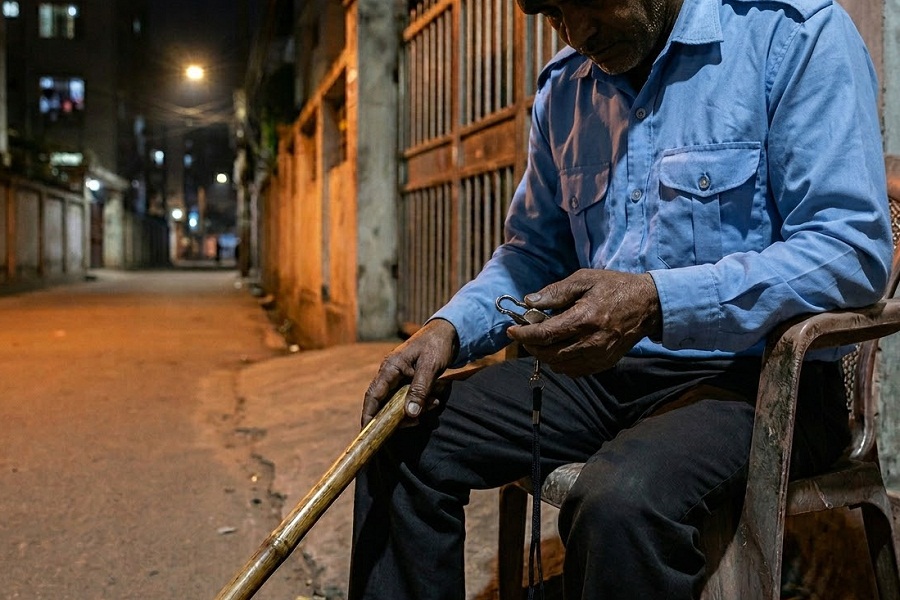
Outside, however, stand the men in uniform, holding whistles and bamboo sticks, guarding residential areas throughout the night. They patrol the area throughout the night to maintain order and provide reassurance.
How do these men, working through the night, spend their Eid?
Raisul Mia (44) has been guarding the nights for 15 years in the Eastern Housing residential area of Pallabi. He speaks of long hours, limited rest, and a routine that rarely changes even during Ramadan.
"The nights are not very different," he says. "We are on duty all the time. There is little chance to pray, and even Sehri has to be done quickly." The same constraints apply beyond Ramadan, with little accommodation for prayer breaks.
During Chand Raat and Eid days, the workload remains unchanged. There are no holidays. "We never get to go back to our home districts," he adds. "It is always my family who comes to visit me here."
Economic pressures have only made things harder. Despite rising inflation, wages have barely increased. Badruddin, another guard, says his salary rose after eight years from 10,000 to just 10,500 taka.
Forkan Ali, who has spent nearly two decades in the profession, describes the strain: "It is hard to live on this salary. It barely covers the minimum cost of living." He also claims that housing committees are often indifferent to their situation.
There is no formal Eid bonus. However, residents sometimes offer small tips or salami, gestures that the guards say bring some sense of appreciation.
Not all aspects of the job are equally difficult. Alamin Hamid, another middle-aged guard, says the workload itself is manageable. Guards are assigned to different spots across the area, which makes the night feel less isolating. "Not everyone sleeps through the night anymore," he notes.
When asked about changing professions, Alamin is uncertain. "I do not know any other work. At this age, it is difficult to start something new."
On Eid nights, the routine continues. Some guards are joined briefly by family members; others pass the time talking among themselves. At times, even the celebrations create tension. "Some residents complain about the sound of fireworks, while others tell us to ignore it," one guard says. "It becomes complicated, but we manage somehow."
The same situation continues on Eid holidays as well. The nightguards keep doing their jobs. Suppose there are more than one nightguards than they could do multiple shifts. Otherwise, be it the day of Eid or the whole holiday, their job is to sit, stand, and walk without any safety precautions, but to ensure the safety of the residents of their area or the building.
For many, Eid is a time to return home, to rest, and to celebrate with family. For these guards, it is another night on duty.
And as the city celebrates, they remain where they have always been- awake, watching, and working.