

Interim govt's rushed move risks depriving workers
Lower profit sharing by foreign energy cos may prompt others to follow suit
Published :
Updated :
 For all latest news, follow The Financial Express Google News channel.
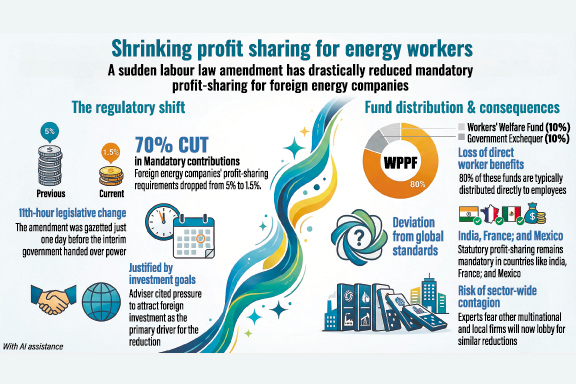
Foreign energy companies' mandatory contribution to workers' profit-sharing funds has been reduced from 5 per cent to 1.5 per cent ahead of the elected government assuming power, raising concerns that other firms may follow suit and deprive workers.
The interim government issued a gazette notification amending the labour law just a day before handing over power to the elected government on February 17.
Experts and workers' leaders have questioned the haste behind the move, saying it allows companies such as Chevron Bangladesh and Tullow Bangladesh to get away with sharing a smaller slice of their profits with workers.
Labour leaders say the interim government proceeded with the revision of the law targeting the Workers' Profit Participation Fund (WPPF) despite objections raised during meetings organised to discuss the issue.
"The interim government should not have taken such a decision. The elected government should reconsider it," said Dr Khondaker Golam Moazzem, research director at the Centre for Policy Dialogue (CPD), a non-government think tank in Bangladesh.
He wondered "what could have prompted the move."
Under the amended labour law, all private companies-except foreign energy companies and readymade garment manufacturers (due to earlier changes)-are required to contribute 5 per cent of their net profits to the WPPF.
For example, if the contribution is Tk 100, Tk 10, or 10 per cent of the contribution, is deposited into the Workers' Welfare Fund meant to support workers' welfare activities. This fund is handled by the respective company.
Another 10 per cent goes to the government exchequer, while the remaining 80 per cent, or Tk 80, is distributed among employees, excluding the company's managing director and chief executive officer.
Many countries, including developed ones, have mandatory WPPFs or similar statutory profit-sharing requirements. These include India, France, Peru, Mexico, Ecuador, Brazil, China and Pakistan.
Such binding contributions from pre-tax or net profits are typically designed to foster a sense of ownership among workers. These funds are often managed by independent boards of trustees.
When contacted by The Financial Express, Brigadier General (Retd) M Sakhawat Hossain, who served as the adviser to the labour and employment ministry during the interim government, declined to comment on the matter.
"I've forgotten what I did. That's why I cannot say anything without seeing the documents," Mr Hossain said.
He, however, said in an earlier interview with a local television channel that he had come under pressure from the energy ministry and the cabinet to introduce the changes to the labour law, which they said were necessary to attract foreign investment.
The law is already loosely enforced. Many companies tend to hide profits to evade taxes, while others are reluctant to contribute to the WPPF.
Against this backdrop, the further reduction in contributions by foreign energy companies could encourage local firms to pressure the government for similar leniency, said CPD's Moazzem.
Babul Akhter, general secretary of the Garment and Industrial Workers Federation and a member of the three-party advisory committee of the labour ministry formed by the interim government, said the ministry had held three meetings to discuss the legal changes.
"We, labour leaders, strongly opposed the proposed reduction in the contribution to the workers' fund." The decision would badly affect workers' interest, he added.
Previously, readymade garment (RMG) companies had also been exempted from paying 5 per cent of profits to the WPPF.
A separate fund, namely the Central Fund, was introduced in 2013, to which RMG companies contribute 0.03 per cent of their export proceeds.
According to Mr Babul, the fund does not directly benefit workers, as it is used for various purposes, including workers' treatment.
Due to greater regulatory vigilance, local companies listed on the stock exchanges are comparatively more compliant than non-listed firms in terms of profit-sharing with workers.
Nevertheless, auditors frequently identify instances of non-compliance related to the WPPF. Listed multinational companies, however, generally adhere strictly to its provisions.
In the changed landscape, the privilege granted to foreign oil and gas companies is likely to prompt other multinational firms to seek similar advantages.
mufazzal.fe@gmail.com