

Published :
Updated :
 For all latest news, follow The Financial Express Google News channel.
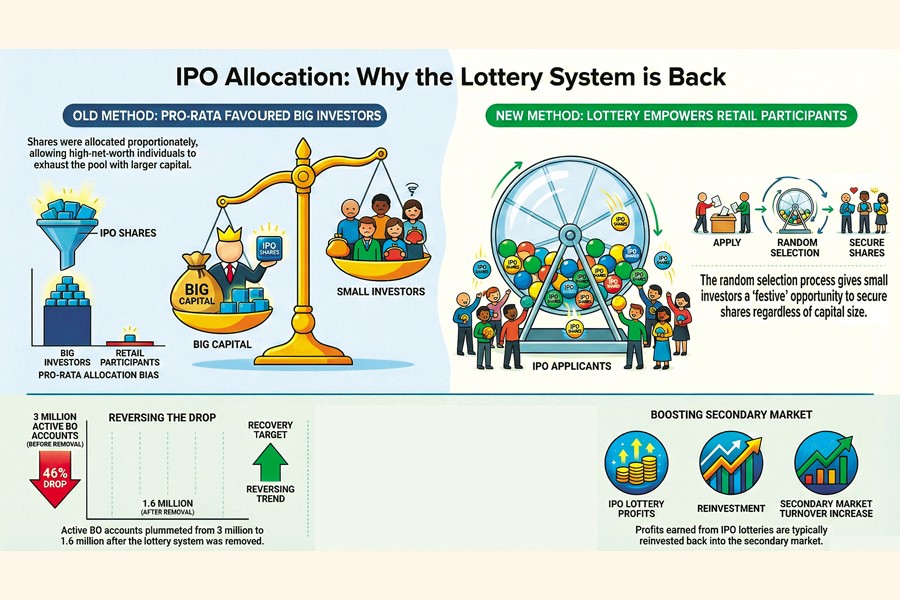
The main reason for restoring the lottery system in primary share allocation is to boost turnover in the secondary market against the backdrop of a persistent investor exodus.
The IPO lottery system was removed in April 2021 after it was repeatedly accused of depriving retail investors of IPO shares. The Bangladesh Securities and Exchange Commission (BSEC) replaced it with the pro-rata allotment system, which enabled share allocation to every valid applicant in proportion to the quantities applied for.
"We have observed that IPO shares were mostly exhausted by high net worth individuals [under the pro-rata system]. They have more money. They applied for more shares and they got more," said BSEC spokesperson Abul Kalam.
According to the market watchdog, the very objective behind removing the lottery system could not be achieved. Instead, enthusiasm surrounding new listings faded as retail investors received only nominal numbers of shares.
The BSEC brought back the lottery system even though the taskforce assigned to suggest capital market reforms made no recommendation on IPO share distribution.
"Out of 200 public opinions that we received [on the revised rules], 171 voted for the lottery system," said Kalam.
"We did not recommend bringing back the lottery system in IPO," said Md Moniruzzaman, managing director and CEO of Prime Bank Securities Ltd, adding that IPO hunters might have pushed for the return of the system.
"They might have given votes in the public opinion. It is true the lottery system encouraged participation with the hope for higher profits," said Moniruzzaman, who was in a focus group responsible for assisting the taskforce.
Under the pro-rata system, the IPO share pool was divided into different investor categories with predefined quotas for each.
The main categories were general investors (including retail and local individuals), non-resident Bangladeshis (NRBs), and eligible investors (institutional or qualified investors). The total number of shares allocated to each category was fixed as a proportion of the IPO size.
That meant if the eligible or institutional portion was oversubscribed, each applicant in this segment received shares in proportion to the amount applied for.
"The pro-rata system prefers big investors," said Kalam.
Another reason for removing the lottery system earlier was to curb investors' speculative behaviour.
The lottery-based IPO process encouraged short-term speculation, with investors applying mainly to gain quick listing profits rather than long-term investment returns.
However, the BSEC took into consideration the steep decline in the number of BO accounts since the repeal of the lottery system.
"There were nearly 3 million BO accounts in the market when the lottery system was in place. Now it has fallen to 1.6 million. Market turnover has also declined. We believe the reintroduction of the lottery system will bring back the festive mood [around listings] and increase turnover," said the BSEC spokesperson.
When retail investors make profits from IPO shares, they reinvest a portion of those profits in the secondary market, Kalam added.
Lottery-driven IPOs used to witness excessive oversubscription-sometimes hundreds of times the required amount-creating operational and settlement pressure in the IPO process.
According to Kalam, this will not happen now as BO account opening has become more tightly regulated. Investors must have a bank account and a bank certificate in their own name before opening a BO account. Opening a bank account requires a national ID card.
"Fake accounts can no longer be used to apply for IPO shares," said the BSEC spokesperson.
The regulator has also eliminated, under the revised IPO rules, the minimum requirement of Tk 50,000 investment in the secondary market for each BO account.
"We have brought back the lottery system to ensure more shares for general investors. We believe this will increase investor participation in the market," Kalam added.
farhan.fardaus@gmail.com